

Inside the Czech National Quantum Strategy
Exclusive insights from Czech Science Envoy - Petr Kavalir

Hey there!
The global quantum landscape is crystallizing into a mix of strategic alliances, national roadmaps, and technology-driven bets. In this edition of The Quantum Vibe, we will know more about the national strategy of Czech Republic — historically known for material science, precision engineering, optics, and a strong scientific tradition, now positioning itself as a quantum nation with ambitions that extend well beyond academic excellence.
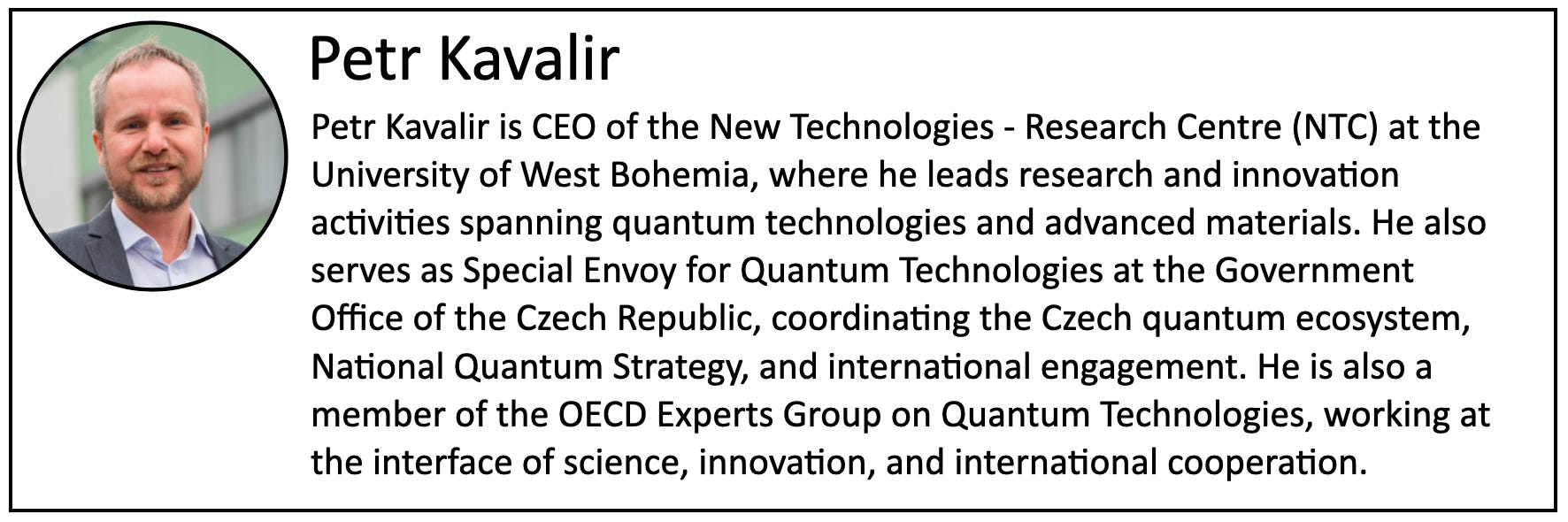
To understand how the strategies are unfolding, I spoke with Petr Kavalir, Special Envoy for Quantum Technologies of the Czech Republic and CEO of the New Technologies – Research Centre. Petr’s insights offers an insider perspective at the Czech National Quantum Strategy and the thinking behind it. Below is the full interview with Petr but before that here are the highlights:
From excellence to systems: The strategy focuses on building a coherent ecosystem aligning talent, infrastructure, software, and industry.
Pragmatic platforms: The near-term emphasis is on hybrid quantum–HPC workflows that can deliver deployable prototypes in materials, chemistry and energy.
Quantum as a product discipline: Embed hands-on hardware access and demand-side pilots into national programs.
Czech Republic plans on making major investments in quantum science and technology. From your perspective as Science Envoy, what are the priority directions for the next 5 -10 years?
If the Czech Republic is serious about making quantum a strategic pillar of its future economy, the priority for the next 5-10 years must be to move beyond isolated excellence and toward a coherent national quantum system. This requires aligning talent, infrastructure, research focus, and industry pull around a shared long-term vision.
The first and most fundamental priority is people and capability building at scale. Quantum technologies are inherently interdisciplinary. We need people who are fluent across boundaries and capable of translating quantum principles into usable technologies.
Second, we must invest in strategic infrastructure that enables real access, not just symbolic capacity. The installation of the LUMI-Q (VLQ) quantum computer at IT4Innovations in Ostrava - integrated into the EuroHPC ecosystem - positions the country as an active player in hybrid quantum - HPC workflows. Furthermore, through the IBM Quantum Innovation Center in the Czech Republic, eight Czech universities and the Czech Academy of Sciences now have coordinated access to IBM quantum computers, software tools, and training resources. This is critical: it accelerates learning, aligns curricula, and allows Czech teams to experiment, benchmark, and co-develop methods on real hardware rather than in simulations alone.
Third, our scientific focus areas must be explicit and balanced. Quantum materials remain a core strength, we are pivoting toward quantum communication, quantum sensing, optics, and metrology. These are areas where Czech expertise in precision instrumentation, photonics and measurement science can deliver near-term economic and societal impact.
Fourth, we must embrace quantum software and quantum AI as strategic layers. Quantum AI, understood broadly as the intersection of quantum algorithms, machine learning, data-driven control, and hybrid quantum–classical workflows, will be central to extracting value from early quantum hardware.
Fifth, the national vision must embed industry engagement from day one. Rather than treating commercialization as a downstream activity, we should design programs that fund co-development, pilot use cases, and early adopters, especially in sensing, metrology, computing, materials discovery, secure communications, and optimization. Bringing incentives for start-ups but also government and public institutions should act as customers where possible.
Finally, our international positioning is key. We will succeed by being a fast, reliable, and deeply integrated partner within European and transatlantic ecosystems.
Czech universities are now deeply engaged in quantum programs and international networks. How are Czech universities evolving their education and research models to build a strong, sustainable quantum talent pipeline from undergraduate training to industry-ready specialists?
At the undergraduate level, we need to make quantum feel less like a distant theory. At the graduate level, the key is hands-on access and interdisciplinary training. Through the Quantum Innovation Center Czech Republic, students gain direct access to IBM´s quantum computers. We want graduates to be „industry-ready“ from day one.
The most important evolution is cultural and institutional: we are encouraging mobility between sectors. This includes joint supervision of PhDs with industry partners and structured internships. We don´t just want people who just “know quantum,” we want talent capable shipping functional code, sensing prototypes, and metrology standards directly into the commercial sector.
What is the take on scaling of technologies? How does Czech Republic plans strong industry engagement? How do you see Czech industry contributing to the quantum ecosystem, and which Czech or European companies and startups do you see as key players in helping translate quantum research into scalable technologies?
Scaling is the moment of truth. It’s where quantum stops being a scientific promise and starts behaving like a technology sector. For Czechia, this means focusing on the layers of the stack where we are naturally competitive: optics, materials, control systems, and precision engineering.
One practical mechanism is to move beyond “collaboration” and into active co-development. We are incentivizing joint labs where companies and academia solve “un-glamorous” but vital scaling problems like device packaging, calibration automation, and manufacturability.
Second, we are creating demand-side pull-through pilot procurement and testbeds. If government, utilities, advanced manufacturers, or infrastructures act as early adopters - especially in sensing, metrology, and secure communications, they provide companies with local market to define their products. This avoids the theoretical vacuum and keeps development grounded in real-world requirements.
Third, we should lean into the European and worldwide quantum ecosystem intelligently. For hardware we can partner with established builders while specializing domestically in enabling components and integration. The VLQ system (developed within the EuroHPC context) is an example of plugging into a European-scale deployment model, which is essential.
As for “the key players,” we should focus on the sectors where Czech industry already competes internationally, such as high-precision manufacturing, optics and photonics, specialized instrumentation, advanced materials processing, and software/HPC/AI engineering. The winning Czech companies, and I believe many will be new startups, will be those the ones that treat quantum as a product discipline-build teams that understand customer requirements, qualify their components, and participate actively in European supply chains and certification regimes. I believe new start-ups will lead the way.
Finally, scaling requires narrative discipline. We should be measuring success not only by research papers, but by prototypes delivered, joint IP created, and systems deployed. If we align incentives around these metrics, Czechia can become a meaningful quantum industrial node.
Looking ahead, what concrete software platforms, hardware systems, or applied products do you expect to emerge from Czech quantum efforts? For example in hybrid quantum-HPC workflows, materials simulation, sensing, or optimization?
First, we are delivering hybrid quantum - HPC. The VLQ system is not a standalone experiment, it is the being integrated with EuroHPC infrastructure, including the KAROLINA supercomputer and the LUMI (Finland) infrastructure. Deliverables include software stacks and a library of “reference workloads” in chemistry, materials and optimization.
Second, I expect applied progress in materials simulation and design especially where quantum methods complement classical approaches. Czech research institutions are exploring how computing complements classical approaches in materials design. The first “products” here will be validated workflows, algorithms, accuracy assessments and domain-specific toolchains.
Third, I expect deliverables in quantum sensing and metrology. Sensing often reaches application readiness earlier than large-scale fault-tolerant computing, and it maps well to Czech strengths in instrumentation and precision engineering. Concrete outcomes include magnetometers, time/frequency-related subsystems, quantum-enhanced measurement modules, and the packaging and calibration methodologies ready for field deployment.
Fourth, I expect progress in education-linked platforms. Initiatives like the Quantum Innovation Center Czech Republic serve as “strategic products”, connecting workforce development directly to hardware access.
Finally, I expect a set of applied deliverables in optimization and industrial experimentation, not because quantum will magically outperform classical solvers tomorrow, but because the discipline of building hybrid pipelines, curating datasets, and validating performance creates immediate value. Companies benefit even before a “quantum advantage” headline, because they modernize their analytics stack and develop talent that understands both classical HPC and emerging quantum methods.
The roadmap is pragmatic: build integrated platforms, prove workflows in materials, chemistry, energy, etc., deploy sensing prototypes, and use national access programs to train a workforce that can keep shipping real-world outcomes.
The message is clear: the Czech quantum strategy stands out for its discipline — building real systems, training industry-ready talent, and turning national strengths into deployable quantum technologies.
That brings us to the end, and many thanks to Petr Kavalir for sharing their insights with The Quantum Vibe community.
That’s that from this issue. Until next time, stay curious!